
Research Areas
The Riera Laboratory investigates how the nervous system regulates metabolism and physiology using advanced mouse genetics and tissue-culture models at the intersection of neuroscience and molecular physiology.
Our recent work identified a novel population of cholecystokinin (CCK)-expressing neurons in the dorsomedial hypothalamus that regulates feeding and energy expenditure. We also uncovered a key role for supraoptic hypothalamic vasopressin neurons in controlling core body temperature and water intake. Remarkably, the physiological functions of these neuronal populations are sexually dimorphic. Dysfunction of these circuits drives weight gain and accelerates physiological aging, respectively.
Future research in the Riera lab aims to design therapeutic strategies to treat insulin resistance, adipose tissue dysfunction and age-related frailty.
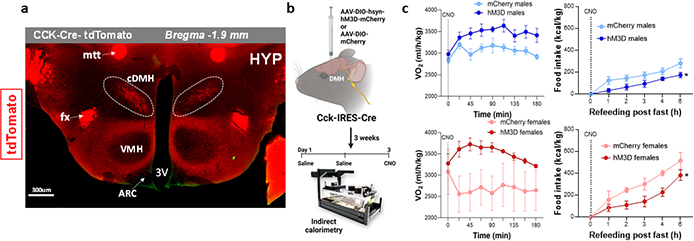
Dorsomedial hypothalamus in the regulation of energy balance. A. tdTomato expression the hypothalamus (HYP) in CCK-cre; Ai14 female mice showing select presence of CCK in neurons from the compact DMH (cDMH). CCK neuronal projections are visible in the arcuate nucleus (ARC), fornix (fx) and mamillothalamic tract (mtt). B. Experimental design for chemogenetic manipulation of Cck-expressing neurons in the DMH. c. Oxygen consumption (VO2) is robustly increased upon DMH-CCK stimulation; Food intake is reduced following chemogenetic activation of DMH-CCK neurons
- Hypothalamic dysfunction in obesity and aging
- Sympathetic regulation of adipose tissue function and lipolysis
- Sex differences in neuronal control of metabolism and physiology
- Neural mechanisms linking metabolic dysfunction to weight gain and physiological aging
- Insulin resistance and the onset of neurodegenerative diseases
Contact the Riera Lab
127 S. San Vicente Blvd.
Advanced Health Sciences Pavilion, Suite A8305
Los Angeles, CA 90048